There are several real-life stories that continue to take over my interest and many of them include true crime. My fascination with the Ed Gein case started when I first read Psycho in 2007. I’ve also read some biographical works on Gein and so, I thought this 2021 graphic novel would be of interest. Harold Schecter wrote the book (having written several books on serial killers, including one on Gein called Deviant) and the art was done by Eric Powell (known for The Goon).
The book begins chronologically, showing us Ed Gein’s upbringing, particularly how his mother treated him, and how her overbearing influence, religious fanaticism, and hatred of the world shaped him. Gein was fiercely devoted to his mother. Eventually, the story of the graphic novel splinters, fast-forwarding us to November 1957 on the night Gein was caught when police found the body of Bernice Worden on his property, hanging like a slaughtered deer in Gein’s shed. The investigation is laid out in detail until everything is uncovered, including Gein murdering Mary Hogan, and robbing several graves and keeping numerous body parts in his house including a suit made of female skin. I won’t go into further detail. The depravity of the Gein case shocked the nation and the idea that a seemingly harmless man living a murderous double life inspired Robert Bloch to write Psycho.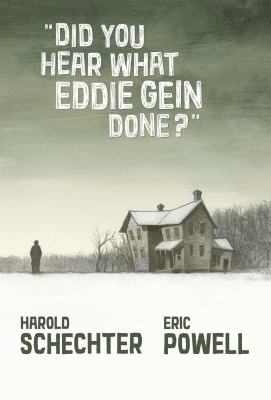
Gein earned nicknames for himself, including the Butcher of Plainfield and the Plainfield Ghoul and would be in a state hospital for the rest of his life, although he eventually stood trial for the murder of Bernice Worden and he was found insane. Gein was inconsistent in his testimony and would either admit to killing the two women or pretend that he had no memory of doing so. The book does an excellent job of showing his shifting perspectives, most of all, bringing home the idea that his sexual and religious fixation on his mother, and his love and hatred for her, prompted him to try to become his mother once she was dead. Based on an audiobook I recently listened to, Mother's Skin by Juliusz J. Manell, Gein's mother did not allow his ego to grow, making him wholly dependent on her, and therefore he did not have a personality of his own. He couldn't think of an existence without her. In his article, “The Shambles of Ed Gein,” Bloch would explain that newspaper accounts of the Gein case were scanty and he never had the opportunity to go to Plainfield, although he lived in Wisconsin, and so he did not realize how close he hit home when he created Norman Bates, the fictional psychopath who became his mother.
I appreciate the fact that Schecter made the connection of how the Gein case influenced pop culture, inspiring Psycho, which of course, led to the Hitchcock film, therefore influencing the creation of the slasher film, and the creation of Texas Chainsaw Massacre (yes, that found footage scene at the beginning of the remake is made up) and Jame Gumb (aka Buffalo Bill) from Silence of the Lambs and Schechter did so without exaggerating the source material. We are mostly treated to the facts of the case in the graphic novel, with probably some reasonable extrapolations when it comes to dialogue between Gein and his family and the thoughts of the characters.
Presenting true crime in an interesting storytelling frame can be challenging, but Schecter did it in a way that made the book compulsive reading. Powell’s line art and hard black inks render distinct and, as far as I can tell, accurate portraits of the real-life people involved in the story without sacrificing the touch needed to make the story come alive as a comic book. Whether it's detailed or impressionistic, Powell can do both with equal skill. This is a top-notch collaboration.
Written by Nick Montelongo
The book begins chronologically, showing us Ed Gein’s upbringing, particularly how his mother treated him, and how her overbearing influence, religious fanaticism, and hatred of the world shaped him. Gein was fiercely devoted to his mother. Eventually, the story of the graphic novel splinters, fast-forwarding us to November 1957 on the night Gein was caught when police found the body of Bernice Worden on his property, hanging like a slaughtered deer in Gein’s shed. The investigation is laid out in detail until everything is uncovered, including Gein murdering Mary Hogan, and robbing several graves and keeping numerous body parts in his house including a suit made of female skin. I won’t go into further detail. The depravity of the Gein case shocked the nation and the idea that a seemingly harmless man living a murderous double life inspired Robert Bloch to write Psycho.
Gein earned nicknames for himself, including the Butcher of Plainfield and the Plainfield Ghoul and would be in a state hospital for the rest of his life, although he eventually stood trial for the murder of Bernice Worden and he was found insane. Gein was inconsistent in his testimony and would either admit to killing the two women or pretend that he had no memory of doing so. The book does an excellent job of showing his shifting perspectives, most of all, bringing home the idea that his sexual and religious fixation on his mother, and his love and hatred for her, prompted him to try to become his mother once she was dead. Based on an audiobook I recently listened to, Mother's Skin by Juliusz J. Manell, Gein's mother did not allow his ego to grow, making him wholly dependent on her, and therefore he did not have a personality of his own. He couldn't think of an existence without her. In his article, “The Shambles of Ed Gein,” Bloch would explain that newspaper accounts of the Gein case were scanty and he never had the opportunity to go to Plainfield, although he lived in Wisconsin, and so he did not realize how close he hit home when he created Norman Bates, the fictional psychopath who became his mother.
I appreciate the fact that Schecter made the connection of how the Gein case influenced pop culture, inspiring Psycho, which of course, led to the Hitchcock film, therefore influencing the creation of the slasher film, and the creation of Texas Chainsaw Massacre (yes, that found footage scene at the beginning of the remake is made up) and Jame Gumb (aka Buffalo Bill) from Silence of the Lambs and Schechter did so without exaggerating the source material. We are mostly treated to the facts of the case in the graphic novel, with probably some reasonable extrapolations when it comes to dialogue between Gein and his family and the thoughts of the characters.
Presenting true crime in an interesting storytelling frame can be challenging, but Schecter did it in a way that made the book compulsive reading. Powell’s line art and hard black inks render distinct and, as far as I can tell, accurate portraits of the real-life people involved in the story without sacrificing the touch needed to make the story come alive as a comic book. Whether it's detailed or impressionistic, Powell can do both with equal skill. This is a top-notch collaboration.
Written by Nick Montelongo
The author does not allow comments to this entry
No comments