I’ve always been prone to hyperbole. I tend to rave about things I love, being completely honest in the moment, but my lists of favorites have changed as often as the weather.
No book touched my heart as deeply as Robert McCammon’s Boy’s Life. It’s probably my favorite book of all time.
There’s been contenders, books that shattered my conceptions of the possibilities of fiction. Peter Straub, Dan Chaon, Robert Cormier have all transcended my established notions of the potential of books.
They don’t come often. I’m certainly not one of these so-called reviewers who throw out five star ratings like rice at a wedding. I remember one guy who boastfully claimed that everything he read so far that year was a five-star book. The indie author chorus cheered the preposterous claim.
David J. Schow, a writer who has my utmost respect, recently asked his social media audience about their most influential books. Titles were listed, then someone asked Dave about his choices. That’s where I sat up and paid attention.
Schow did not make a list. He only named one title. It was a book I heard about here and there over the years. Maybe John Waters mentioned it, or perhaps Peter Straub.
I always meant to read Theodore Roszak’s 1991 novel, Flicker, but I forgot about it. Years passed since it was published and I was preoccupied with other books and life matters.
I knew Roszak was an academician and I assumed Flicker would be a dense, dry, somnambulant tome that would be a lot of work to get through.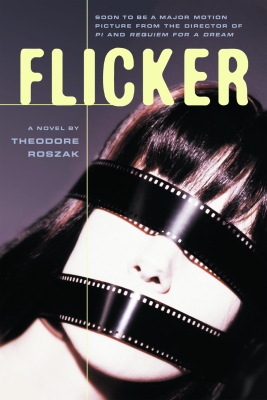
Theodore Roszak was a Professor Emeritus Cal State and is perhaps best known for his Sociological books about the nineteen sixties. You know, the age group that broke down barriers of civil rights, equality, and artistic freedom? Sure, many of them turned into old fools, but that's the way it goes. Today's young people will end of the same way. If, that is, energy drinks and processed food don't kill them before they reach old age.
I’ve been in a slump of late. I try this book, that one, and end up disappointed. They’re all acclaimed, but few are worth my time. The truth is, when it comes to books I am a picky son of a bitch.
I desperately needed something new, so I ordered a copy of Flicker. The subject matter certainly appealed to me. The novel deals with the history of the movies and a shadowy director who made obscure horror movies in Hollywood’s golden age.
I was immediately aware that Roszak is a brilliant writer. The language is rich, the characters vivid, and the atmosphere is realistic.
Jonathan is a young film fan in the nineteen fifties with ambitions to enter the world of professional criticism. He begins to spend time in a decrepit little theater that plays art films.
We enter the world of film projection, distribution, and collecting. Jonathan makes the acquaintance of a haughty film fan named Clare and they enter into a relationship.
Clare is a fascinating character. In one sense I admire her zeal and ruthless intelligence, but in another sense I think it would be difficult to spend much time with her.
Jonathan becomes interested in the movies of one Max Castle, a once-renowned director who ended up making cheap horror movies.
Castle’s films leave much to be desired in terms of quality, especially in comparison with the movies the group normally watches. Yet there is something about Castle that can’t be denied. A strange, compelling power that brings forth feelings of hopeless dread.
Jonathan’s interest turns to obsession as he tries to locate every movie Castle ever made. It ends up being a tricky path that leads him across the globe and enmeshes Jonathan into a global conspiracy with deep religious ties.
Clare beseeches Jonathan not to delve too deeply into the world of Max Castle. There’s something bad in the movies. Perhaps even evil. It could devour him.
The search leads Jonathan through a succession of Castle’s surviving associates. Actors, a cinematographer, cultists, historians, and even corpulent old Orson Welles.
Consider the process of projecting film. Twenty-four frames a second is what it takes to make translucent images appear to have fluid motion to the human eye. Oddly, the same number of hours in a day and the revolutions of the planet around the sun.
Consider also the concept of Persistence of Vision. Our eyes cannot take in the floating images in a film, so the brain takes over and fills in the blanks. The eye essentially records an image for a microsecond, allowing it to smoothly flow with consecutive images as they pass before us. How does that work as we try to process reality with our eyes and brain? What, in fact, is reality?
Perhaps it’s unwise to pursue such thoughts. That way lies madness
Film travels across a beam of light, onto a screen, then is reflected back into our eyes and brain. But what of television? An entire step is eliminated. The images go directly from the source to our brains.
Jonathan discovers subliminal images beneath the surface of Castle’s movies. It’s an ancient process that began in the pre-film days of kaleidoscopes. If it was possible to affect people’s minds with that old technology, how manipulative are our precious cell phones?
Parts of Flicker were like a slap in my face. The old art theater is converted into a grindhouse, showing bloody exploitation pictures. Jonathan expresses tremendous distaste for movies like Blood Feast, Pink Flamingos, and Plan 9 from Outer Space. I happen to like those movies, but I also love Breathless, Jules and Jim, La Dolce Vita, and The Seventh Seal.
Jonathan and Clare believe society is being nudged further into savagery by the images in exploitation movies. He ends up meeting a bizarre child prodigy who makes unbelievably grotesque movies that are wildly embraced by new young audiences.
Does art influence life or does life influence art? Are the powers-that-be behind our media consumption merely making money by providing us with entertainment, or is there something insidious going on behind the scenes? As is noted in Flicker, bring up a conspiracy theater and you’ll face ridicule.
The plot of Flicker somewhat resembles The DaVinci Code, which was published many years later. Flicker could never, however, be as popular as the Dan Brown books. It’s too smart, too disorienting, too unnerving for the masses.
Some of Flicker reads like an academic treatise. At times it feels like a history lesson. I laughed and cringed. There are parts that could have come out of a splatterpunk book. It's like a spy novel, a thriller, and a horror story. The novel certainly went places I wasn't expecting it to go, and there's no way I could have predicted where it ended up.
I will never look at movies, or the history of Hollywood, in the same way after reading Flicker. This novel upset my concepts of what movies are and how we perceive them. It, in turns, delighted me, scared me, and challenges everything I know, or think I know, about the magic of the movies.
Raise your hand if you watched Twin Peaks: The Return. You know how the end of the series was so disturbing. How David Lynch slowly led viewers to a disorienting conclusion, leaving us feeling lost and empty. I felt sick and confused at the fate of Agent Cooper, even if I didn’t completely understand what was going on. I got the same feeling when I finished Flicker. Only worse.
I had about eighty pages to go last night, and I soldiered on to the finish. I wish I would have waited and read the last chapter by the light of day. The novel got into my head and troubled my sleep in ways no other book has.
Flicker is the best novel I’ve ever read.
Written by Mark Sieber
No book touched my heart as deeply as Robert McCammon’s Boy’s Life. It’s probably my favorite book of all time.
There’s been contenders, books that shattered my conceptions of the possibilities of fiction. Peter Straub, Dan Chaon, Robert Cormier have all transcended my established notions of the potential of books.
They don’t come often. I’m certainly not one of these so-called reviewers who throw out five star ratings like rice at a wedding. I remember one guy who boastfully claimed that everything he read so far that year was a five-star book. The indie author chorus cheered the preposterous claim.
David J. Schow, a writer who has my utmost respect, recently asked his social media audience about their most influential books. Titles were listed, then someone asked Dave about his choices. That’s where I sat up and paid attention.
Schow did not make a list. He only named one title. It was a book I heard about here and there over the years. Maybe John Waters mentioned it, or perhaps Peter Straub.
I always meant to read Theodore Roszak’s 1991 novel, Flicker, but I forgot about it. Years passed since it was published and I was preoccupied with other books and life matters.
I knew Roszak was an academician and I assumed Flicker would be a dense, dry, somnambulant tome that would be a lot of work to get through.
Theodore Roszak was a Professor Emeritus Cal State and is perhaps best known for his Sociological books about the nineteen sixties. You know, the age group that broke down barriers of civil rights, equality, and artistic freedom? Sure, many of them turned into old fools, but that's the way it goes. Today's young people will end of the same way. If, that is, energy drinks and processed food don't kill them before they reach old age.
I’ve been in a slump of late. I try this book, that one, and end up disappointed. They’re all acclaimed, but few are worth my time. The truth is, when it comes to books I am a picky son of a bitch.
I desperately needed something new, so I ordered a copy of Flicker. The subject matter certainly appealed to me. The novel deals with the history of the movies and a shadowy director who made obscure horror movies in Hollywood’s golden age.
I was immediately aware that Roszak is a brilliant writer. The language is rich, the characters vivid, and the atmosphere is realistic.
Jonathan is a young film fan in the nineteen fifties with ambitions to enter the world of professional criticism. He begins to spend time in a decrepit little theater that plays art films.
We enter the world of film projection, distribution, and collecting. Jonathan makes the acquaintance of a haughty film fan named Clare and they enter into a relationship.
Clare is a fascinating character. In one sense I admire her zeal and ruthless intelligence, but in another sense I think it would be difficult to spend much time with her.
Jonathan becomes interested in the movies of one Max Castle, a once-renowned director who ended up making cheap horror movies.
Castle’s films leave much to be desired in terms of quality, especially in comparison with the movies the group normally watches. Yet there is something about Castle that can’t be denied. A strange, compelling power that brings forth feelings of hopeless dread.
Jonathan’s interest turns to obsession as he tries to locate every movie Castle ever made. It ends up being a tricky path that leads him across the globe and enmeshes Jonathan into a global conspiracy with deep religious ties.
Clare beseeches Jonathan not to delve too deeply into the world of Max Castle. There’s something bad in the movies. Perhaps even evil. It could devour him.
The search leads Jonathan through a succession of Castle’s surviving associates. Actors, a cinematographer, cultists, historians, and even corpulent old Orson Welles.
Consider the process of projecting film. Twenty-four frames a second is what it takes to make translucent images appear to have fluid motion to the human eye. Oddly, the same number of hours in a day and the revolutions of the planet around the sun.
Consider also the concept of Persistence of Vision. Our eyes cannot take in the floating images in a film, so the brain takes over and fills in the blanks. The eye essentially records an image for a microsecond, allowing it to smoothly flow with consecutive images as they pass before us. How does that work as we try to process reality with our eyes and brain? What, in fact, is reality?
Perhaps it’s unwise to pursue such thoughts. That way lies madness
Film travels across a beam of light, onto a screen, then is reflected back into our eyes and brain. But what of television? An entire step is eliminated. The images go directly from the source to our brains.
Jonathan discovers subliminal images beneath the surface of Castle’s movies. It’s an ancient process that began in the pre-film days of kaleidoscopes. If it was possible to affect people’s minds with that old technology, how manipulative are our precious cell phones?
Parts of Flicker were like a slap in my face. The old art theater is converted into a grindhouse, showing bloody exploitation pictures. Jonathan expresses tremendous distaste for movies like Blood Feast, Pink Flamingos, and Plan 9 from Outer Space. I happen to like those movies, but I also love Breathless, Jules and Jim, La Dolce Vita, and The Seventh Seal.
Jonathan and Clare believe society is being nudged further into savagery by the images in exploitation movies. He ends up meeting a bizarre child prodigy who makes unbelievably grotesque movies that are wildly embraced by new young audiences.
Does art influence life or does life influence art? Are the powers-that-be behind our media consumption merely making money by providing us with entertainment, or is there something insidious going on behind the scenes? As is noted in Flicker, bring up a conspiracy theater and you’ll face ridicule.
The plot of Flicker somewhat resembles The DaVinci Code, which was published many years later. Flicker could never, however, be as popular as the Dan Brown books. It’s too smart, too disorienting, too unnerving for the masses.
Some of Flicker reads like an academic treatise. At times it feels like a history lesson. I laughed and cringed. There are parts that could have come out of a splatterpunk book. It's like a spy novel, a thriller, and a horror story. The novel certainly went places I wasn't expecting it to go, and there's no way I could have predicted where it ended up.
I will never look at movies, or the history of Hollywood, in the same way after reading Flicker. This novel upset my concepts of what movies are and how we perceive them. It, in turns, delighted me, scared me, and challenges everything I know, or think I know, about the magic of the movies.
Raise your hand if you watched Twin Peaks: The Return. You know how the end of the series was so disturbing. How David Lynch slowly led viewers to a disorienting conclusion, leaving us feeling lost and empty. I felt sick and confused at the fate of Agent Cooper, even if I didn’t completely understand what was going on. I got the same feeling when I finished Flicker. Only worse.
I had about eighty pages to go last night, and I soldiered on to the finish. I wish I would have waited and read the last chapter by the light of day. The novel got into my head and troubled my sleep in ways no other book has.
Flicker is the best novel I’ve ever read.
Written by Mark Sieber
The author does not allow comments to this entry
No comments