|

In a time when it seems like there are new horror writers trying to break into publishing almost every day, it's hard to keep the excitement level up. More are trying to make it all the time, and as always, few will ultimately make the cut. And fewer are delivering what I consider to be satisfying works of fiction. But I heard some good word about a young writer named Ryan C. Thomas. Enough so that I bought and read his book, The Summer I Died. I thought it had pluck and guts and energy and I was moved to do one of my all-too-infrequent reviews on it here at Horror Drive-In (read review here).
Ryan is one of the ones that I have big hopes for and I look forward to any new publications in the future. For now he kindly took time out of his insanely demanding schedule to answer some questions for our readers.
Horror Drive-In: How's it going, Ryan?
Ryan C. Thomas: Very good. Although I was just looking through an edit of the new novel and they found some egregious mistakes that have me slapping my own head. Gah! No matter how much you think you wrote a flawless novel something always pops up. In this case one of the characters is carrying a briefcase which suddenly becomes a gym bag. What! How'd that happen? haha. Editors deserve more credit than they get.
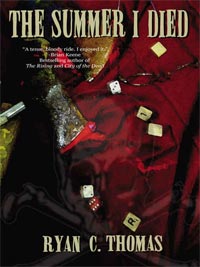 HD-I: The Summer I Died is your first published novel, but is it the first you wrote? HD-I: The Summer I Died is your first published novel, but is it the first you wrote?
RCT: First novel, yes. Like I've told others, it was never meant to be a novel. It was just a writing exercise I was doing to remember what it was like shooting a .44 magnum. It kind of got away on me, I guess.
HD-I: It's one of the most graphically violent stories I've ever read. I know that I liked it, but were other reviewers as kind?
RCT: You know, most reviews have been surprisingly kind. The toughest review was from. Horror-web, and it was still a good review: 3 out of 5 stars. Considering how tough Horror-web can be, I'll take it. A couple of readers online pooh-poohed it, but what are you gonna do...readers are readers, they're definitely entitled to their opinions. Interestingly I don't get much negative feedback on the amount of violence and gore. I hear the occasional, "It's a little over the top, don't ya think?" but most people seem to really enjoy the bloodshed. Which, when you think about it, is a bit creepy.
HD-I: I guess it appeals to fans of slasher movies, which are popular now.
RCT: Yes.There's no doubt I had slasher fans in mind. I'm a huge fan of slasher films myself, both the good ones and the cheesy so-bad-they're-good ones. When I sent out my query letters for The Summer I Died I actually used Hollywood's new spurt of horror films as a selling point. I figured if Wolf Creek and House of Wax were making money, a book about an ax wielding psychopath might appeal to the same audience. I don't know that it worked, but I tried.
HD-I: Was The Summer I Died a hard sell?
RCT: Very very hard. Naturally I started at the top and worked my way down. It got rejected across the board. The worst rejection letters were the ones that said it was well done but there was no way it could be marketed because it was too violent. Coscom was the last publisher I was waiting to hear from, figuring it'd get rejected again, and to my surprise they seemed to "get it." I'm grateful to them for putting it out and they've been a pleasure to work with, very professional despite being an indie publisher on a small scale.
Having said that, that first submission process was a real learning experience that has led me to look at my "career" in a different light. It's called the Publishing Industry for a reason, because there's money involved, and I believe writers need to acknowledge that. With Summer, the page count was low, the grossout factor a sure turn off for mass appeal, and the metaphors too abundant. Don't get me wrong, I'm proud of the book, but I can see why some publishers turned it down. But of course the story wouldn't really work if you took out all the gore, so it was bound to land on the shoulders of an indie that understands niche markets.
HD-I: Let me backpedal a bit. Earlier you praised editors and said that they deserve more credit. That's refreshing to hear from a young writer. But did Coscom request any edits for The Summer I Died? For content or anything else?
RCT: Coscom told me up front they wanted to honor their writers' words, so they didn't make toomany content changes. Whether that's good or bad is subjective I guess. They did point out any plot holes or confusing text, but in terms of the gore, they left it. Of course they fixed any typos and such. But overall, they gave it a polish and left it largely in tact. You know, they're into horror as much as their comic titles, so they could stomach it with a chuckle. But before I sent it off I had a few colleagues look it over, so you could argue it was fairly well edited already. (With the exception of one major boner of a typo that I'm not bringing up since only one person has caught it so far).
HD-I: Finally, before we move on from The Summer I Died, I assume you wrote it quite a while ago. Would you change anything about it now?
RCT: As Sure as Mrs. Seaver is a fox! I guess what bugs me the most is the "should have fixed that sentence" mindset. I'm sure all writers look back at their early work and cringe and go, "Gah, it's so green!" But there are a few clunkers that irk me still, that should have been culled. I wrote it when I was 26/27 and I'm 32 now, and I feel that I've gained some artistic growth (not to mention I've since landed a day job as an editor). Specifically, I've learned my lesson about metaphors: you can definitely have too many. I've also learned how to say what I'm trying to say in the least amount of words that fit the point. You know, there's a word for just about anything in this world, so you don't have to say "The beam separating the window over the door." It's called a transom. In Summer, I did that kind of thing here and there...a seasoned writer (and a good editor ) knows not to do that. You don't want to get bogged down with syntax, you need to get the story moving. Since the book came out, I've helped edit a few indie books that contain these same mistakes and I can't help but notice the age of the writers. It goes back to what the professionals argue about on the boards--wait till you're ready and have a polished product. Don't jump the gun. Maybe that's me being nitpicky, but it makes a huge difference over the course of 300 pages. But if we're talking just the overall story, the only thing I might have added was a bit more law enforcement research. I did talk to an escape artist to get the gist of how to crack handcuffs (he even sent me an illustrated PDF!) but I could have amped up the police stuff. It was myopic on my part because my step brother is a cop and knows correct procedure. For my third novel I'm writing, which is a supernatural detective thriller, my step brother is helping me and he loves it. He hands the pages over to the detectives in his department and they fix all the errors.
HD-I: I understand your day job is in publishing.
RCT: Yes, I'm the executive editor for a luxury lifestyle magazine distributed in Southern California. It has it's perks. I've jumped out of planes, driven ferraris, dined all over for free, interviewed celebrities (just got off the phone with Ivanka Trump yesterday in fact, and yes I'm name dropping because my cat doesn't care when I tell him). Although most days I wish I was just the Travel editor...she gets to go everywhere and I'm so jealous. It sure as hell beats that job I had in the packaging warehouse (the one Tooth works at in The Summer I Died.)
HD-I: Does your experience with it help you with your writing or the selling of your work?
RCT: I dunno. In a round about way it helps with my writing. More specifically it helps with finding out what will hold people's attentions. I've become very strict about cutting the fat with my writers. Bottom line is people don't read. They especially don't read magazines no matter what they say. What they do is look at pictures. So anything being printed has got to be right to the point and engrossing. For me, it means choosing editorial that is timely, entertaining, and well written. And if I can toot my own horn for a second here, since coming on board the magazine has swept the local awards shows so I believe I'm dong it right (To get an inside look at these award shows you'll have to read Ratings Game). Of course, these awards may have less to do with me and more to do with firing the old boring writers and bringing in ringers like Shocklines' Nick Cook, Punk Horror's Paul Stuart, and the vastly talented Cody Goodfellow-- I do very little editing on their work. Over time you see what writing sells, what people respond to. That doesn't necessarily apply to horror writing, but it's all writing in the end. It's sort of like a heavy metal musician teaching music to gradeschoolers...you get in some kind of practice everyday even if its not exactly your style of choice.
As for sales--what sales? It's still as hard as ever to make a sale; what editors and publishers want is very subjective and I'm still learning. Possibly it's helped with query letters, since I get a handful each day and I know which ones stick out to me, but fiction sales are still pretty tough. All my sales these days are, I believe, based on the large monetary bribes I send along. Seriously though, I'm just glad to be making sales at all.
You know, this brings up a very touchy subject that will probably result in some negative feedback, and maybe even get me blackballed to a degree but I don't care. The bottom line is magazines have to make money to stay in business so you can't blame them for gravitating toward popular writers' works. You have to sell subscriptions and you have to sell ads. I know, as someone who does it for a living, that editors choose what sells first. It's a business. Ivanka Trump lives and works in New York, but people want to read about her, so we did the interview. There are people here in SD who want to be in our personality section, who might even have more interesting stories, but if your name on the cover is not going to help me sell more copies, then you don't go in. That's how it works and I believe it's the same with fiction. Which is not to say the paradigm is wrong--I believe new writers SHOULD pay their dues and work their way up. That's America, that's business. And it's smart business. Everyone can get there eventually, but that doesn't mean the paradigm should be ignored or lied about. I've read tons of stories from people who can't get published to save their lives that are way better than what I read in most lit mags. But, editors have to print what sells in order to survive. Again, there's nothing wrong with it, but I hate the argument on the boards. That's as far as I'll go on the subject... commence burning me in effigy.
HD-I: Honestly, Ryan, from a reader's point of view, I'm sure that you're right. When I consider buying an anthology, I look at the names on the contents page first. I've gotten better over the years, but in the old days...if there weren't enough known names in the book, I'd probably skip it. And I can't be the only one that feels that way.
RCT: Me too. "Enough Known Names" being the rub. I love discovering new authors, but the odds I'll pick up an antho without a single author I know or have heard positive things about is extremely rare. I love the fact that small press publishers are keeping this genre alive right now. There's some great stuff flying under the radar. But it's a double edged sword—just because an antho is out from an indie publisher doesn't mean it's good, doesn't mean it's been edited well, etc. So I figure, if it's got at least a couple popular authors in it, I'll drop my money on it and ignore anything bad, revel in anything newly discovered. That's me personally. If you are a risk taker, by all means shop however you like. Just be sure to drop me an email withrecommendations.
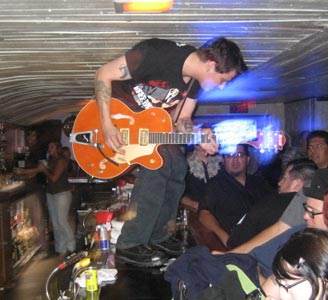 HD-I: Moving on, I understand you play in a band? HD-I: Moving on, I understand you play in a band?
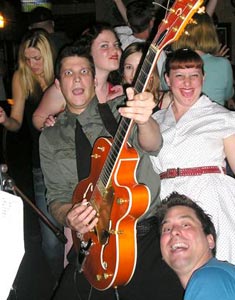
RCH: do. I play guitar and share singing duties (sing is subjective in this case). We're called The Buzzbombs and we play punked-up covers of oldies like Buddy Holly, Elvis, Gene Vincent, etc. We're a lot like The Stray Cats (even cover some SC songs) with the upright bass and all. And we go a little nuts at shows with our acrobatics. One of these days I'm gonna break my neck jumping off the bar in mid solo. But that's the price of entertainment, right?
We just released our first album last summer, San Diego Shindig. The album is actually all original material about drinking beer and driving hotrods. The beer part we do, but we sold the hotrods...too much money. I have a Camry now. It's very punk rock. haha. You can listen and check us out on www.thebuzzbombs.com or, of course, the world dominating Myspace at myspace.com/thebuzzbombs. Speaking of the beer songs, the local paper, San Diego Reader, does a list of the hottest things happening in San Diego and awarded us with Best Beer Anthem for our song, The San Diego Drinking Song. As you can tell, we're very much a local band and are all about instilling pride in the local scene. And what a good scene it is. Much better than when I lived in New York City.
HD-I: No Cramps cover songs? (laughs) They're one of my favorite bands!
RCT: I love the Cramps as well, but we don't do any of their covers. I'm not sure why. Never came up I guess. We cover the Reverend Horton Heat, The Amazing Crowns (not to be confused with the Royal Crown Revue), stuff like that. Sometimes we'll throw in a curve ball like The Clash, or The Beastie Boys or SoftCell. But mostly, when we're not playing originals, we're souping up the oldies.
HD-I: A day job, a burgeoning writing career and playing in a band??? Is there any spare time in your life?
RCT: No. Not really. My poor girlfriend pretty much has to keep a calendar with the dates I'm free. I also have a second job doing freelance writing/editing, so my days are full up. I don't know when it happened, but at some point in the last five years I did a complete 180. I used to spend all my days sitting around playing video games, just wasting tons of time. I mean, I would literally spend over 12 hours on the computer, which is depressing. About the time I started writing The Summer I Died, something happened internally. The worlds in my head became more fun to hang out in than the ones on my computer screen. I haven't really played video games in nearly four years, and I stopped caring about television. Now, if I'm idle for more then fifteen minutes I get real antsy and start thinking about stories I could be writing, or songs I could be arranging. I need to be working all the time, even if it's just plotting a story in my head while I'm food shopping--which explains how I fail to notice buying Depends and lipgloss and all the other weird shit that ends up surprising me when I get home.
HDI: I think it boils down to the fact that humans are creatures of habit. I've been changing some of my bad ones this past year too.
RCT: Some of the real bad ones still have me in a strangle hold, namely the cigarettes. I'll quit for a month, smoke for a month, quit for a month, smoke for a month, etc. Being in a rock band makes that side of things hard to ignore. (Putting a nickel in the "lame excuse jar" now.)
 HD-I: I understand that you have quite a few new pieces of fiction coming out soon. HD-I: I understand that you have quite a few new pieces of fiction coming out soon.
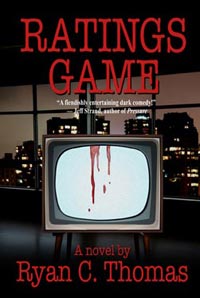
RCT: Why yes I do. I guess I should start with the Permuted Press stuff. Jacob has been absolutely awesome to work with. He pays on time, he hires great editors, artists, authors, and is just very professional. I was very disappointed when I didn't make it into the first Undead anthology. You could just tell it was going to be a fun book. When I heard he was doing another I jumped at it, and this time I was accepted--3 years of experience having been gained in the interim. Then, wouldn't you know, for whatever reason ( I honestly don't remember) I sent him another one and he accepted both. They'll be in Undead 2 and 3. I was elated to have both stories accepted, so you can imagine my surprise when he offered me a novella deal in Elements of the Apocalypse. The book will contain four novellas about the end of the world, each one brought on by a different element (earth, wind, fire, water). I'm water. They also accepted a zombie novella I wrote for the Headshot Quartet book (again, four novellas, but this time about zombies). Headshot Quartet is a cool little project because each author involved (John Sunseri, DL Snell, David Dunwoody, and myself) all went pretty far outside the box to try and keep the zombie vibe fresh. All four of those books should be released by late summer/early fall. I also want to mention Punk Horror's antho, The Vault of Punk Horror, which I'll have a story in alongside great authors like Cody Goodfellow, John Shirley, Christa Faust and others. The proceeds will support domestic abuse shelters. Last I heard it'll be out in the fall. I've been offered a short story collection deal as well, which will be out around Christmas. I'll leave that one a bit nebulous for now until I sign the contract. Working title is Siren, which is a short story of mine with a sad history. And finally, Ratings Game, which is my new novel. Cohort Press, a new startup, has set the release date for September (wow, looks like fall is going to be my season, haha). It'll be a TPB, and I think they're starting with 1000 copies. It's a satirical look at journalism in which two serial killers get a little creative and brazen as they compete for coverage on the nightly news. There's blood, there's laughs, there's cannibalism, the usual. Jeff Strand called it a "A fiendishly entertaining dark comedy!" and I didn't even have to pay him! (Yet.) You can check my website for a list of all short stories coming out (www.ryancthomas.com).
And naturally, there are plenty more stories in the works that will need a home soon.
HD-I: Wow, all that sounds fantastic. I'm especially excited about The Ratings Game.
Okay Ryan, obviously you're an incredibly busy man. I won't tie you up any more. Before we say goodbye, I have one more question. Is it your goal to be a full-time fiction writer? I realize that's kind of the Holy Grail for those getting their feet wet in publishing.
RCT: Well, the simple answer is yes, everyone wants to make their riches doing what they love. But I'm not holding my breath. Not yet. I realize many full time fiction writers make less money than a Taco Bell manager. I love John Lithgow's declaration in the movie Orange County when he tells his son nobody makes money writing, and his son counters with "Stephen King, Anne Rice, and Tom Clancy." Lithgow yells, "Three people in the history of literature!"
The reality of "making it big" is something I learned about when I had dreams of being a rock star. I toured the country, I paid big bucks for a good producer, I walked down the streets of Manhattan handing out CDs just to create a buzz. All it did was make me nuts. The reality is maybe 1% of musicians make it big, and many of them are just in the right place at the right time. It used to frustrate me. I got bitter for a while and that sucked the fun out of the band. When I finally came to terms with that, life got a hell of a lot more fun. Now I'm used to it and completely enjoy working on a local level. The idea is to stay creative and get what money and respect you can for it if that's your goal. I have my moments, like when people want my autograph at a show (which means less than you think it does; drunk people will ask a hair brush for an autograph), but I've come to terms with the fact I'll never be on MTV, and that's fine. I like where I'm at with music. Making money, being creative, getting some recognition, that's something to be proud of. So--to get back to the point--I apply this to my fiction writing. I've got levels I'd like to achieve, but they're realistic, they're not Rowling-esque.
HD-I: Ryan, thanks again for being here at Horror Drive-In. It's been a lot of fun.
RCT: Thank you. This site is great fun. I'm honored that you even considered me worthy for an interview, haha. Most days I feel like a grain of sand in a field of boulders. Things like this make me feel okay about that.
|



 (More than) A Few Words With Ryan C. Thomas